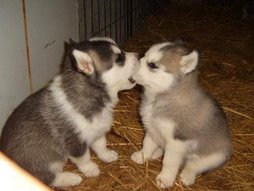
Playing with your dog (part II)

Another good idea is to combine training and playing.
Example: If you take your dog for a walk in open space, like a park, the mountain, a beach etc, and your dog starts walking away from you. Then a good thing to do is not to call him/her back, you can turn and start walking to the opposite direction. As soon as your dog understands that you are not close s/he will come back to you. As soon as s/he does that you can praise and pet him/her. This is a very good exercise in order to make your dog follow you when s/he is unleashed and also a great way to show him/her who the leader is in a very nice and effective way.

Examples of unacceptable ways of playing with your dog include:
Teasing, slapping, wrestling, chasing, allowing him/her to bark at you. You should not allow your dog to demand that you play with him/her. Also you should not use your hands as a toy, allowing him to nip, and tug-of-war.

Playing with your dog

The first step is to find the appropriate play and chew toys for your puppy. Some examples are:

  • Kong or Rhino toys
  • Nylabones
  • Hard rubber balls large enough so they don’t get stuck in your dog’s throat
  • Soft flying disks
  • Interactive play toys like Buster cube (a square box where you can put food in)

Some examples of unacceptable toys are:

  • Tennis balls and stuffed toys
  • Ropes and similar, as such toys can lead some dogs to become aggressive
  • Rubber toys that can be chewed into little pieces, as these can be threatening to your dog’s health

In order to make the desired toys attractive to your dog, they must become a main source of interaction between you and your dog. Play with your dog and his/her toys. If you also appraise the dog when playing with the toys, you will make him/her seek them out on their own. When s/he seeks them out you should praise this behavior.

A great game to play with your dog is fetch using a toy that you are holding. You throw the toy and give the “fetch” order to your dog. The desired reaction would be for the dog to bring back the toy and either leaves it in front of your feet or in your hands. This can happen either on its own or after you giving the command. In case the dog doesn’t bring back the toy, s/he runs off, refuses to give it back or just stops playing, then you should stop playing for 10-15 minutes.

Teach your dog proper house behavior

doIf you want to your dog to be able to move around the house, then you must make certain that s/he is ready to do so. This means that s/he follows the rules you have set, i.e s/he is calm and obedient. If your dog is not properly trained before left unleashed in the house this could create numerous problems. Don’t feel bad for your dog this will only happen for a short period, until s/he learns what you want after consistent and proper training.

In the begging you should leash your puppy and walk him/her around the house in order to teach the appropriated behavior. When your puppy tries to reach for a shoe, or walks towards your bedroom, you can gently pool him/her back and continue your walk around the house.

When you are teaching your puppy proper behavior in the house you must be consistent and have patience.


After you have finished with your walk in the house you should lead the dog to a safe place. You can leash him/her somewhere s/he can see you and teach him/her to stay there and not walk around in the house. Please be careful when you leash your puppy. Avoid places where s/he can climb because it can be dangerous for him/her to hang from the leash!!! You can use a rag, or pillow for your puppy to stay on, or give him/her a toy, in order to make your puppy enjoy staying in the safe spot you have chosen.

If you use a crate, you can make it really enjoyable to your dog by putting all his/her toys and give him/her some food treats while in there. Then the dog will associate positively and s/he will want to stay there.


If your puppy starts doing "crazy" things when in the house, like running around or grabbing items,don't worry, this is normal and shows energy. What you can do is take him/her outside to play and exercise.

Clear roles for you and your dog

Your role as the “boss” must be clear to your dog. Also his or her role must also be clear. Some basic tips:

  • You can give him/her food, after you have finished yours.
  • Before s/he is aloud to eat you need to say it is OK.
  • If s/he doesn’t finish the whole meal at once then the food must be taken away until the next meal.
  • Don’t allow your dog to sleep on your bed, or other furniture that you use.
  • The dog should not be allowed into your bedroom, or even your kitchen.

Use the things your dog likes to teach her/him obedience

A very important rule to follow is to use the things your dog likes in order to teach her/him obedience. If you give your dog things s/he likes for free, then there is no reason to be obedient. S/he needs to understand that you have a "give and take" relationship. S/he has to “give” something (obedience) in order to gain what s/he likes (food treat).

In order to encourage a behavior you should use reinforcers. These reinforcers vary. They can be something your dog really enjoys for example: food treats, rubbing behind her/his ears, playing with a favorite toy or it can be a verbal appraisal like “Good”. The above mentioned reinforcers can be combined.
For example: you can say “Good” and also give a food treat in order to increase your dogs awareness of the situation. This combination can stop when your dog responds to what you want 9 out of 10 times.

Considering the above mentioned practices we conclude that: If you give your dog the things s/he enjoys only after s/he has obeyed, s/he will anticipate obedience, because s/he knows that it only leads to the things s/he really enjoys!